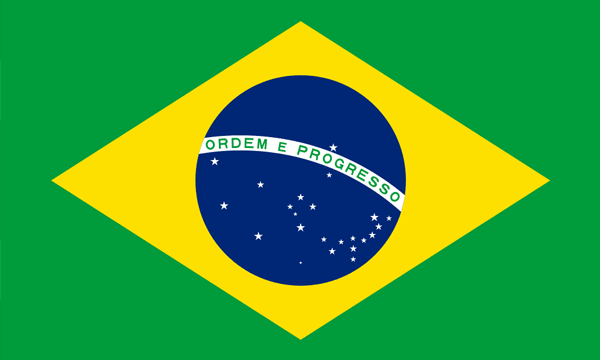
Brazil by region: where to go
Rio and surrounding coast
Búzios
Two and a half hours north of Rio is the fashionable beach resort of Armaçao de Búzios, 27 sandy coves spread around a peninsula. Búzios itself has a vibrant nightlife, excellent bars and restaurants, and some lovely pousadas.
Rio de Janeiro
While Brasilia is the official capital, and is fascinating for anyone with an interest in modern architecture, Brazil’s spiritual capital is Rio de Janeiro, with surely one of the most beautiful settings in the world. The Corcovado and Sugar Loaf mountains overshadow the city and the beaches include famous Copacabana and fashionable Ipanema. Tourists flock here in February or March for the annual Carnival, probably the most spectacular in the world.
Petropolis
Petrópolis, in the hills above Rio, was emperor Dom Pedro II’s summer retreat and his modest palace is now an interesting museum. While the town is scruffy, there are some lovely small inns nearby.
Paraty
240km south of Rio, along a pretty coastal road, is the 17th century colonial port of Paraty, whose cobbled centre has been declared a national historic monument.
Ilha Grande
A stunning island, a short drive south of Rio along Brazil's picturesque 'Green Coast', Ihla Grande is linked to the mainland via the ferry ports of Angra or Mangaratiba. The main town, Abraão, is set against a dramatic backdrop of mountains and lush atlantic rainforest that tumbles onto golden beaches nestled within secluded coves. Accommodation is rustic but there are wonderful trails throughout the island and countless beaches to explore.
São Paulo
São Paulo, Brazil’s largest city, has some interesting markets (such as the Hippie market in the Praça da Republica) and a snake farm at Butantã, where much of the world's serum used to be produced. MOMA, the Museum of Modern Art is worth a visit. It is the commercial capital of Brazil, as São Paulo state is where most of the country's agricultural and industrial wealth is concentrated.
The Central Region
Minas Gerais
Inland from Rio is the state of Minas Gerais, with many pretty colonial towns such as Ouro Preto and Tiradentes. Minas was a major source of wealth during the colonial era due to its mineral riches.
Brasilia
Capital of Brazil since 1960 when the honour was moved from Rio, Brasilia is a modern metropolis designed and purpose built over 4 years during the late 50's by the young architect Oscar Niemeyer as a futuristic vision of Brazil's intent, testimony to the national slogan "order and progress". From above, the city resembles a plane (or a butterfly to the more romantic) and was named a UNESCO World Heritage Site in 1987.
The Amazon
The largest and densest rainforest in the world boasts more plant and animal species than any other jungle, creating a paradise for would-be explorers, naturalists and wildlife enthusiasts. Whilst growing economic activity in the region has resulted in much environmental damage, particularly the indiscriminate use of mercury by gold prospectors and large scale deforestation, there is a growing awareness among many Brazilians that the Amazon is a unique resource in need of protection. For the most rewarding insight to the wonders of the jungle we recommend a stay in one of several lodges, the majority of which are within easy reach of Manaus. In the 18th century Alexander von Humboldt and Alfred Wallace both launched scientific expeditions into the interior and the mysterious disappearance of the British explorer, Colonel Fawcett, still baffles the world's press.
Manaus
Manaus, on the banks of the Rio Negro, flourished during the 19th century rubber boom, when the famous opera house and floating docks were built. Today economic activity has returned as it is a duty-free area for (mainly) the electrical industry. There are colourful markets (particularly for fish) and a boat trip to the meeting of the waters (where the brown Amazon, know here as the Solimoes, meets the black waters of the Rio Negro) is popular.
Alta Floresta
This is the southernmost tip of the Amazon rainforest although the area is being constantly eroded by cattle and crop farming which means that the forested area is receding. Once heading north, however, a combination of private reserves and state parks allows a vast protected area of primary rainforest with abundant wildlife and great natural beauty.
North-east: Recife to Bahia
Recife and Olinda
Recife is laid out along a beach, similar to Rio, while more secluded beaches are found further south at Porto de Galinhas and beyond. Olinda, a short drive from Recife and a former capital, is a pretty town with cobbled streets and colonial architecture. Both São Luis further north in Maranhão and Olinda offer wonderfully preserved, and in part restored, examples of Brazilian Baroque.
Fernando de Noronha
350km off the Atlantic coast, Fernando de Noronha is an archipelago of 21 islands, formed by volcanic activity about 12 million years ago. The main island is 15km long and its principal feature is the huge Morro do Pico rock which rises impossibly from the green landscape. 70% of the archipelago is a National Marine Park, generally accepted as one of the most untouched and unique marine systems in the world. The island is ringed by a variety of lovely and deserted beaches, the calmest of which are on the leeward side. There are many sites of interest on land, but a unique feature of the island is the presence of spinner dolphins (stenella longinostris), around 1,200 of which congregate nearly every morning in Golfinho Bay and whose aerial displays are a delight to watch. Noronha is a paradise for divers of all standards, with an average temperature of 26°C and visibility up to 50m. Sea turtles, dolphins and even the occasional shark can be seen in addition to a wonderful display of tropical fish. Pousadas (none of which are actually on the beach) can be booked up months in advance, particularly during holiday periods (July, August, Christmas, Easter and Carnival).
Maceió
Maceió is the capital of the small, friendly state of Alagoas and mainly a sugar port. The best beaches are north of the city and have a protecting coral reef about 1km out. Marechal Deodoro, is an attractive colonial town 22km south of Maceió, overlooking Lagoa Manguaba, with some interesting buildings.
Salvador
Salvador, the capital of Bahia state, overlooks the vast Todos os Santos Bay. The city is split into two levels connected by lifts and a network of steep back streets which lead up to the Pelourinho, with some of the best-preserved colonial architecture in the Americas. It has numerous interesting churches and the rich cultural heritage of the African-influenced religion, Candomblé. Bahia has some wonderful beaches with a range of accommodation to suit all tastes - secluded beaches and family run pousadas in Morro de São Paulo, comfortable resorts around Praia do Forte and Porto Seguro and romantic hideaways near Ilheus.
Morro de Sao Paulo and Boipeba
Morro de Sao Paulo is a pretty island, reached by boat or 20 minute flight from Salvador. Laid out along 5 beaches, with a fort, cobbled streets and small family run pousadas, there is a beach for everyone some more lively than others! Boipeba is a smaller island, less developed and very laid back, it can be reached from mainland Brazil (with short boat ride) and from Morro de Sao Paulo.
Chapada Diamantina
6 hours’ drive inland is the Chapada Diamantina, a beautiful area of caves, streams and mesas with excellent trekking and comfortable country inns in the old colonial mining village of Lençois.
Ilheus, Itacaré and Peninsula de Maraú
Ilheus, in Southern Bahia, is an interesting city with some beautiful coastline. 65km north of Ilheus is the popular town of Itacaré with its cobbled streets, interesting architecture, beautiful beaches, rivers, Atlantic rainforest and Cocoa plantations. The Peninsula de Maraú has wonderful, unspoilt beaches with natural swimming pools and coral reefs. The vegetation is varied; beach scrub, Atlantic rain forest, mangroves, lakes and islands. It has a lovely relaxed, friendly atmosphere and many of the roads are sandy tracks where 4x4 vehicles are necessary. The peninsula can be accessed from either Itacaré or Salvador.
Porto Seguro, Arraial d'Ajuda and Trancoso
Porto Seguro, in Southern Bahia, is a popular holiday resort for Brazilians and the gateway to the beautiful, unspoilt beaches visited from Arraial d'Ajuda and Trancoso, an unspoilt fashionable fishing village with charming posadas, boutique shops and excellent restaurants.
North-east: São Luis to Natal
São Luis
São Luis is the capital of Maranhao state and the heart of the city is on an island connected by bridges to the mainland. Founded by the French and also owned for short times by the Dutch and Portugeuse, European influences are everywhere. It is also an old slaving port and much of the African culture remains. The colonial centre is being restored with the help of UNESCO and the city comes alive in the evenings, particularly at the weekends.
Lençois Maranhenses and the Parnaiba delta
East of São Luis lie the endless dunes of the Lençois Maranhenses - 155,000 hectares of white sand, which are full of fresh water lagoons from March and October (the rainy season is January-July). The Parnaiba delta is the third-largest in the world, and its mangroves and islands are a haven for wildlife.
Jericoacoara
A small village reached only along the beach or over the sand dunes. It has a beautiful wide beach with imposing sand dunes which is a must to climb up and watch the sunset. A very relaxing spot.
Natal
Natal is a busy city whose suburbs have some lovely beaches and good hotels. Its proximity to the lively fishing village of Pipa and the sand dunes at Genipabu, just to the north, make a stay of a number of days worthwhile.
Cariri Region
Heading inland from Natal and Recife, you can visit the fascinating Carirí region, once home to the megafauna of the Pleistocene era: mastodons, giant sloths and sabre-toothed tigers. Enormous boulders perch on rounded granite hills, dinosaurs have left fossilised footprints in ancient lake beds, and there are signs of human occupation dating back tens of thousands of years.
The Pantanal
Like the Llanos in neighbouring Venezuela, the northern Pantanal is home to a dazzling array of wildlife. This huge seasonal wetland attracts 300 species of birds (including hyacinth macaws, jabiru storks, ibis, guans, parakeets and parrots), and a wide range of animal life, making it a paradise for naturalists. There are two distinct seasons: in the rainy season (December to March, wettest in February) the region floods and access becomes restricted. The beginning of the dry season (May to August) is the best time to see birds, thousands of which nest in the trees, filling the air with their mating calls, while the white sand river beaches are exposed for caimans to bask in the sun. Capybaras (giant guinea pig) are everywhere, and with luck one can see marsh deer, giant river otters, and even the elusive tapir and jaguar.
The best way to see the Pantanal is to stay on a fazenda (farm). Domestic airlines serve the two cities which lie on the edge of the Pantanal - Cuiabá and Campo Grande.
Bonito
In the southern Pantanal, 300km from Campo Grande in the limestone Serra da Bodoquena hills, is the small town of Bonito. Tourism was first developed here about 15 years ago when settlers and residents realised the attraction of the caves and crystal-clear rivers. You can snorkel with massive dourado, float down rivers and over small waterfalls, or admire stalactites in limestone caves.
The South: Paraná and Curitiba
Curitiba
Curitiba lies at 900m on the Serra do Mar plateau. A lovely city in its own right, it is also a good starting point from which to explore the Atlantic rainforest and coastal islands.
Morretes and the Atlantic rainforest
One of the most spectacular train journeys in South America cuts through mountains and forests of Brazilian pine (araucaria angustifolia) before dropping into steamy tropical Atlantic rainforest that shrouds the southern coast. Once a week the train continues to Paranaguá, Brazil's second-largest port, and otherwise terminates at Morretes, a sleepy colonial village renowned for its barreado, a stew cooked for 24 hours. The village is a good base to explore the tropical forest, or, for a more authentic jungle experience, the Superagüi National Park, 34,000 hectares of protected Atlantic Rainforest (mata atlantica) is a short boat ride away through the channels of the bay. The area is a picturesque mix of mountains, forests, mangroves and beaches and recognised as being more biodiverse than the Amazon itself.
Ilha do Mel
Historic Ilha do Mel, once a haven for hippies and surfers, now offers a good mix of simple pousadas and long deserted beaches.
The South: Santa Catarina and Iguassu
Santa Catarina: coasts
In the state of Santa Catarina (whose attractive capital, Florianópolis, is on an island) there are huge tracts of well-preserved Atlantic rainforest. From July to early October awesome southern right whales, which grow up to 17 metres in length, come to this beautiful coastline to breed. The world’s second most endangered whale is now returning to shores where once it was hunted close to extinction. At Laguna, once capital of Guiseppe Garibaldi’s ill-fated separatist republic, fishermen work with dolphins to herd shoals towards their nets. Praia do Rosa is a favoured destination for surfers.
The Serra Geral
The monumental escarpment of the Serra Geral plateau rears upwards, its misty cliffs topped with ancient monkey puzzle trees.
Iguassu Falls
Since the release of the film ‘The Mission’, the majestic Iguassu Falls have become even more popular with visitors. The river Iguaçu emerges from forested banks to plunge over a series of cliffs and create a breathtaking spectacle, higher than Niagara and wider than the Victoria Falls. There are only two hotels next to the falls themselves, and a good network of walkways. An excellent Bird Park houses many exotic bird and butterfly species, which can easily be observed at close range.